
I Accidentally Quit Doom Scrolling
Here’s What Replaced It.
The Build Don’t Scroll Origin Story
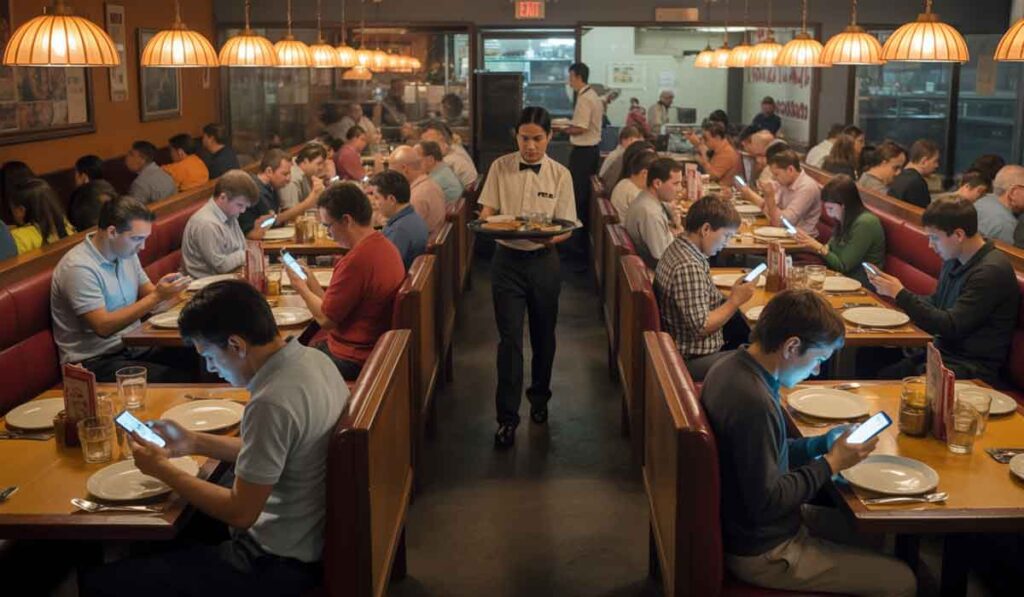
I took my father and his girlfriend to dinner in 2018.
Nothing fancy. A typical family restaurant chain. We sat in a booth toward the back of a big dining room.
I looked around.
- Every table.
- Every booth.
- Heads down.
- Thumbs moving.
- Faces glowing.
Silence.
The only human voice in the entire room belonged to the waiter, and he was being paid to talk to us…
Families together, but alone. Bodies at the same table, minds in different feeds.
I remember thinking: this is the future?
That was 2018.
It’s 2026 now. The problem didn’t get better. It got worse.
Way worse…
64% of Americans now identify as doomscrollers.
81% of Gen Z.
The average American spends 1,916 hours per year on their smartphone.
That’s 80 full days. Gone.
We “lose” 3 days every month to scrolling. Not using our phones productively.
- Just scrolling.
- Consuming.
- Numbing.
- Slowly dying inside
And 55% of us do it right before bed, which is the worst possible time for our brains…
Sound familiar?
Maybe you’ve tried to stop?
- Deleted the apps.
- Set screen time limits.
- Switched to grayscale mode.
- Maybe it worked for a few days?
Then you were right back where you started. Or worse.
I was too!
Until I accidentally discovered something that changed everything.
I didn’t quit scrolling. I replaced it.
And I’m going to show you exactly how it happened.
What Doom Scrolling Actually Destroys
This isn’t about wasted time.
I mean, it is. But that’s not the worst part.
The worst part is what it does to the people who love you.
And what it does to your brain.
Your Relationships
One husband on Reddit described his wife’s phone addiction like this:
“I just want my wife back, not this empty shell. It kinda reminds me of dementia, where the person is an empty shell of their former self, and every so often they’re back and you catch a glimpse of the person that they used to be.”
Read that again.

He compared doom scrolling to dementia.
And he’s not alone.
26% of couples who can’t control their phone use say their marriage may end in divorce.
46% of people report being “phubbed” by their partner. Phone snubbed. Ignored for a screen.
One woman wrote that her husband scrolls for 12 hours a day.
They’ve been intimate once in the past year. She tries to initiate. He refuses.
Another said TikTok ended her marriage.
When she told her husband it felt like they were getting divorced because of TikTok, she was stunned that he agreed.
The phones aren’t causing the problems.
But they’re making it impossible to fix them.
Your Children
A mother posted on Reddit that her 2.5 year old daughter grabbed her phone and said:
“Mommy, put your phone down.”
She wrote: “Hearing her say that hit me hard.“

Another parent responded: “Mine said the same thing. She’s 2 and a half. It punched my gut.“
These children can barely form sentences.
But they already know they’re competing with a screen for their parents’ attention.
The research confirms it.
Parents are 5X more likely to ignore their child’s bid for attention while on a phone.
Parents are twice as likely to be on phones during meals than their own kids.
And children of phubbing parents show higher rates of depression, anxiety, and behavioral problems.
The kids are watching. And learning.
Your Brain
In 2024, a cognitive neuroscientist testified before the United States Congress.
His finding was devastating.
Gen Z is the first generation in over 200 years to be cognitively worse than their parents.
On every measure.
- Attention.
- Memory.
- Literacy.
- Numeracy.
- Executive functioning.
- Even IQ.
All down!
Despite more schooling than any generation before them…

The research spans 80 countries and 60 years.
The pattern is consistent.
When screens enter education, cognitive performance drops.
Students using computers 5 hours daily score 2/3 of a standard deviation worse than students who rarely touch tech.
The SAT had to literally redefine “reading comprehension.” It used to require analyzing a 750 word passage.
Now it’s 54 separate sentences you skim through.
The doctor’s words: “We didn’t improve education. That’s not progress, that is surrender.”
Those students are now entering the workforce.
With degraded cognitive abilities.
Competing for entry-level jobs that require 3 years of experience, they never had a chance to build…
Your Mental Health
People who don’t doom scroll are:
45% more likely to be satisfied with their mental health.
37% more likely to be satisfied with their sleep.
19% more likely to be satisfied with their overall life.
Meanwhile, 74% of severely problematic scrollers report mental health problems. Compared to just 8% of everyone else.
Scrolling before bed means 48 fewer minutes of sleep per week. Your brain can’t wind down when you’re flooding it with variable rewards until the moment you close your eyes.
Your Time
Here’s the math nobody wants to do.
4 hours of scrolling per day equals 100 days per year.
A third of your waking life. Gone.
“It’s been five years since I graduated high school, and I feel like I’ve accomplished very little, having squandered so much valuable time on my phone and social media.”
Five years. Gone.
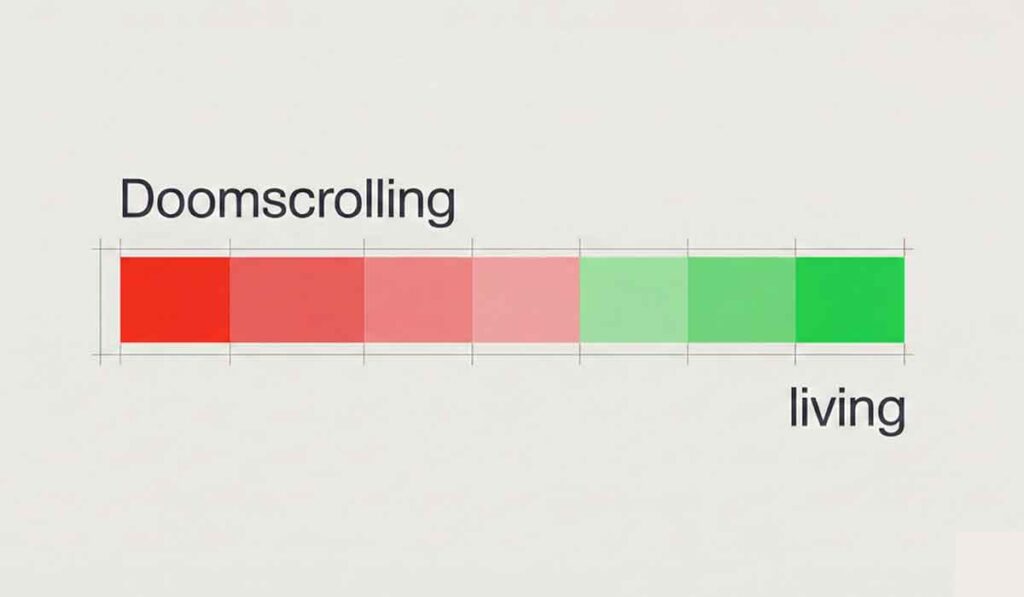
Another calculated it this way: every hour you scroll daily adds up to 23 days per year.
Four hours per day is nearly 100 days. That’s a quarter of your waking life.
Same hours could mean 43 new skills per year using the 20 hour rule.
Same hours. Completely different outcomes.
Have you felt that way too?
That creeping sense that time is slipping away, one scroll at a time?
You’ve probably tried to stop.
Everyone has.
It doesn’t work.
Here’s why.
Why You Can’t Stop
You’re not weak.
You’re not lazy.
You’re not broken.
You’re fighting a machine designed by some of the smartest engineers on the planet, backed by billions of dollars in behavioral research.
And you’re fighting it with willpower.
That’s not a fair fight.
The Slot Machine in Your Pocket
Your phone uses the exact same psychology as a casino.

It’s called a variable reward schedule.
Here’s how it works.
- Sometimes you scroll and find something interesting.
- Sometimes you don’t.
- You never know when the next good thing is coming.
That unpredictability is the trap.
Your brain releases more dopamine for uncertain rewards than for guaranteed ones.
The anticipation is the high. Not the reward itself.
- So you keep scrolling.
- Chasing the next hit.
- Never knowing when it’s coming.
Same mechanism that keeps people pulling slot machine levers for hours.
Except that the slot machine is in your pocket. And it’s free. And it’s with you 24 hours a day.
Your Brain on Scrolling
Each scroll activates your nucleus accumbens.
The brain’s reward center.
Same region that lights up for addictive substances.
- Each negative headline increases clicks by 2.3%.
- Your threat detection system evolved to prioritize bad news.
- The algorithms know this.
- They feed you what you can’t look away from.
Over time, your brain adapts.

It takes more stimulation to feel the same reward.
- Normal activities feel boring.
- A book can’t compete.
- A conversation can’t compete.
- Your own thoughts can’t compete.
The most visceral description of compulsion came from r/nosurf:
“I couldn’t stop doom scrolling even though my insides were screaming at me to stop. I felt so helpless and unable to control myself. Everytime I try to cut my usage, I become a starved animal…”
That’s not a character flaw.
That’s a hijacked reward system.
Why Everything You’ve Tried Has Failed
- You’ve deleted the apps.
- Then reinstalled them a week later.
- You’ve set screen time limits.
- Then tapped “ignore limit” every single time.
- You’ve tried grayscale mode.
- Your brain adapted in three days.
- You’ve tried willpower.
It works until it doesn’t.
Which is usually around 9pm when you’re tired and your defenses are down.
“I’ve tried everything: Switched to a dumb phone, kept my phone in monochrome mode, installed ScreenZen and blocked almost every site I could think of… But when I don’t scroll, the world suddenly feels unbearably slow and boring. No matter how many restrictions I put on myself, my brain finds a way around them.”

Sound familiar?
Here’s why none of it works.
The Data Nobody Tells You
A systematic review of 23 studies measured what actually works for breaking screen addiction.
The results:
- Restriction based approaches: 20% success rate.
- Full abstinence: 25% success rate.
- Replacement based approaches: 83% success rate.
Read that again.
Trying to limit your use? 20% chance it works.
Trying to quit completely? 25%.
Replacing the habit with something else? 83%.
Four times more effective.
The science is clear.
You can’t quit a dopamine source. You can only replace it.
Every time you try to restrict, you’re fighting your biology.
Every time you try to replace, you’re working with it.
The Real Problem
Doom scrolling isn’t the problem.
It’s a symptom.
The real problem is that your brain needs stimulation…
- Novelty.
- Reward.
- Progress.
Scrolling gives you a cheap version of all three.
The solution isn’t to eliminate the need.
The solution is to meet the need differently.
I didn’t figure this out from research.
I discovered it by accident.
How I Accidentally Quit
July 2025.
I was trying to figure out Meta’s new Andromeda ad system.
If you run Facebook ads, you know. Everything changed. The old playbooks stopped working…
So I did what everyone does. I went to YouTube.
- Watched the “experts.”
- Took notes.
- Got more confused.
These guys were making predictions. Guessing.
Nobody actually knew how the new system worked yet.
I was frustrated. Stuck. Needed answers nobody had.
So I tried something different.
I opened Claude. The AI.
Not to get answers. To think out loud.

I uploaded everything I’d found to AI.
- Research papers.
- YouTube video transcriptions.
- Screenshots.
- Ad account data.
- Half-formed theories.
Then I started asking questions.
Not “tell me how Andromeda works.” That wouldn’t help. Nobody knew yet.
Instead: “Here’s what I’m seeing in my account. Here’s what I think is happening. What am I missing?”
Back and forth. For hours.
I’d share an observation. Claude would push back or expand on it. I’d add my own experience. We’d build on that together.
Twelve hours over three days.
By the end, I had an 80% complete advertising system built from our collaboration.
My thinking plus AI processing.
Something I couldn’t have built alone.
Something the AI couldn’t have built without my experience and persistance.
That was cool.
But that’s not the accident.
The Part I Didn’t Expect
A few days later, I realized something strange.
I hadn’t checked Facebook.
Not “checked less.” Hadn’t checked at all.
I’d forgotten it existed.

A week went by. Then two.
I actually had to force myself to open the app. It felt like a chore.
This was weird. I’d been a regular scroller for years. Not the worst, but consistent.
The usual pattern.
- Bored? Open Facebook.
- Waiting? Open Facebook.
- Can’t sleep? Open Facebook.
Now? Nothing. No pull. No craving.
What happened?
The Insight
I didn’t quit doom scrolling.
I replaced it.
- Same brain.
- Same need for stimulation.
- Same craving for novelty and reward.
But instead of getting cheap dopamine from other people’s content, I was getting real dopamine from building something.
The brainstorming sessions with Claude gave me everything scrolling used to give me.
- Novelty? Every conversation went somewhere new.
- Reward? I was solving actual problems.
- Progress? I could see what I built.
Except now I had something to show for it.
I wasn’t consuming. I was building.
Same hours. Completely different outcome.
The Distinction That Changes Everything
Remember the cognitive neuroscientist who testified to Congress?
He warned about passive screen consumption.
And he’s right. Passive consumption degrades your brain.
But here’s what he didn’t say.
It’s not the screen. It’s what you do on it.
Passive consumption and active creation are opposite behaviors.
They use the same device. They produce opposite results.
Scrolling TikTok? Passive. Your brain receives. Processes shallowly. Moves on. Repeat.
Building with AI? Active. Your brain engages. Solves problems. Creates something. Grows.
I didn’t give up screens. I didn’t delete my phone. I didn’t rely on willpower.
I just changed what I did on the screen.
And my brain stopped wanting the old thing.
What Changed For Me
I wake up excited now!!!
Not to check notifications. Not to see what I missed.
Excited to build. To think. To create.
I’m doing more deep thinking than I’ve done in years. Maybe ever.
People say AI makes you dumb. That it does the thinking for you.
My experience is the opposite.
I’m thinking harder than ever because…
- I have a partner that can keep up.
- That pushes back.
- That doesn’t let me stay surface level.
The scrolling never did that.
The scrolling just burned time and left me empty.
This fills me up.
Build Don’t Scroll
I didn’t have a name for it at first.
I just knew what worked.
When I felt the urge to scroll, I opened Claude instead.
- Started a conversation.
- Worked on something.
- The craving went away.
Not because I resisted it. Because I fed it something better.
That’s when I realized this wasn’t just a personal hack.
This was a framework… Build Don’t Scroll.
The Principle
Your brain wants stimulation. That’s not going to change.
The question is where it gets it.
Option one: Consume what other people create. Scroll. React. Forget. Repeat.
Option two: Create something yourself. Think. Build. Learn. Keep.
Same amount of time. Same screen. Same brain chemistry.
Completely different life.

The Math
Let’s get specific.
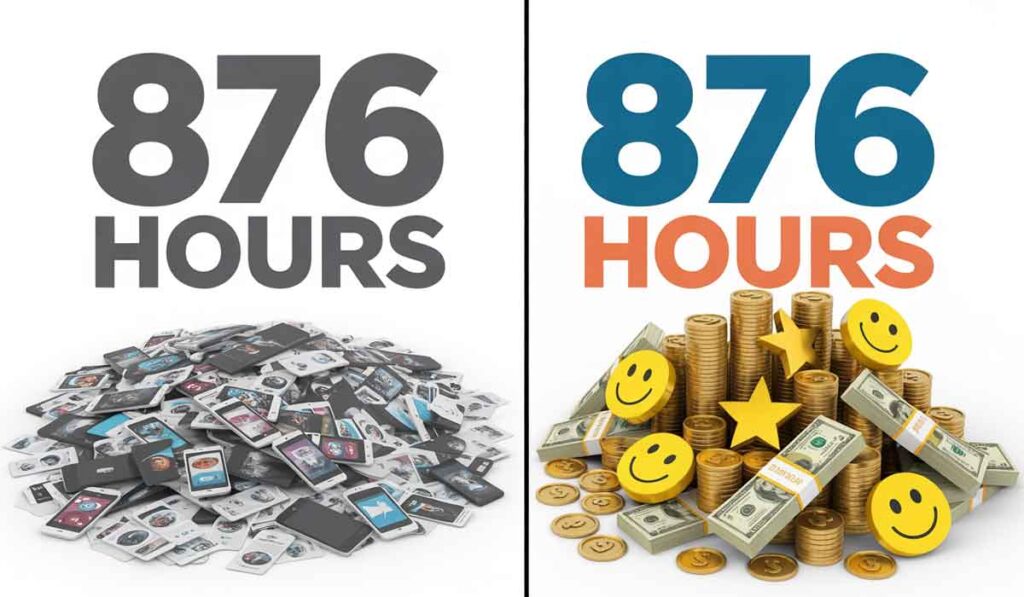
The average American scrolls 876 hours per year.
That’s not a guess. That’s the data.
Here’s what you could do with those same 876 hours.
Using the 20-hour rule, which says you can get competent at any new skill in 20 focused hours, that’s 43 new skills per year!!!
Forty-three.
- Guitar.
- Spanish.
- Video editing.
- Public speaking.
- Coding basics.
- Negotiation.
- Writing.
- Photography.
Pick any 43 you want.
Or scroll through the same recycled content for another year and learn nothing.
Same hours. Your choice.
What Building Actually Looks Like
This isn’t about becoming a coder or launching a startup.
Building can be small.
- It can be a conversation with AI where you work through a problem at your job.
- It can be brainstorming a side project you’ve had in your head for three years.
- It can be finally organizing your thoughts about something you care about.
- It can be learning how something works instead of just watching someone else explain it.
The bar is low.
- Did you create something?
- Did you think through something?
- Did you make progress on something?
Then you built!
One person who made the switch described it like this:
“I’ve started reconnecting with old friends I had intended to contact but never did because I was too wrapped up in my phone. I’m finally engaging in activities I’ve wanted to pursue for years.”
That’s what happens when you stop consuming and start building.
The things you always meant to do? You actually do them.
This Is Bigger Than Quitting an App
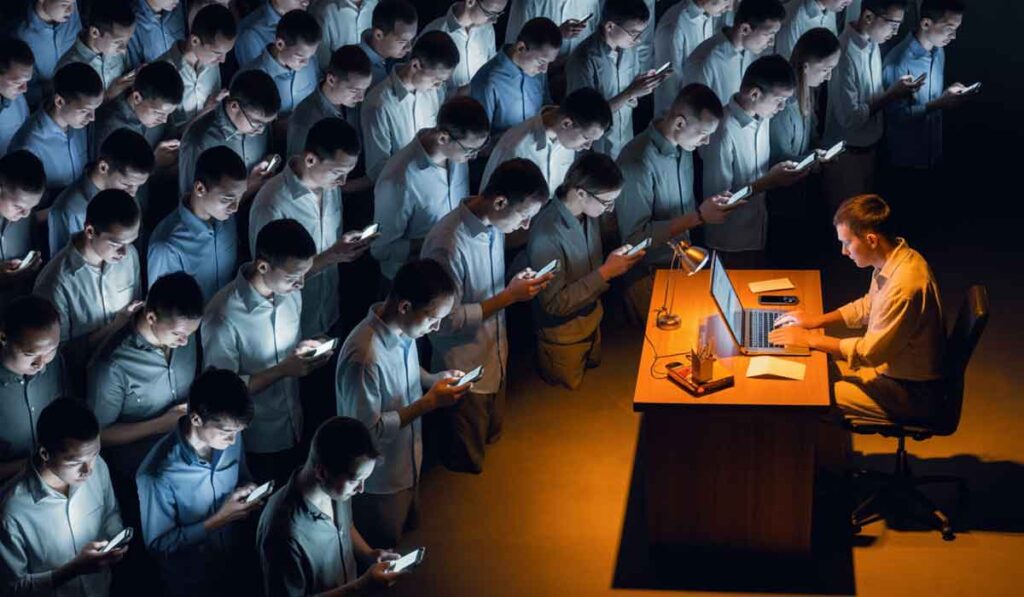
I started sharing what I discovered.
First with friends. Then clients. Then online.
The response was overwhelming.
People weren’t just interested. They were desperate.
Message after message from people who felt trapped.
- Who’d tried everything.
- Who thought something was wrong with them.
Nothing was wrong with them. They just didn’t have a replacement.
That’s when I realized this wasn’t just about me quitting Facebook.
This was a movement waiting to happen.
The 95 and the 5
Here’s what I’ve noticed since AI went mainstream.
~95% of people use it wrong.
They treat it like a search engine. Type a question. Get an answer. Move on.
- Or they use it to write emails they don’t want to write.
- Summarize articles they don’t want to read.
- Automate the things they find boring.
They’re using AI to avoid thinking.
And every time they do, they’re proving they’re replaceable.
If AI can do your job with a generic prompt, why would anyone pay you to do it?
Then there’s the ~5%.
They use AI differently.
- They bring their own thinking to the table.
- Their experience.
- Their judgment.
- Their expertise.
- Their ideals.
They don’t ask AI to think for them. They think WITH it.
The AI handles the processing. They provide the intelligence.
Together, they build things neither could build alone.
I call this The Intelligence Merge.
Your intelligence plus AI capability. Not replacement. Partnership.
The 95% scroll and consume, and prove they’re probably replaceable.
The 5% build and create and become irreplaceable.
Which group do you want to be in?
Why This Matters Now
AI is accelerating everything.
Jobs that existed five years ago are disappearing. Skills that mattered last year are becoming commodities.
The people who will thrive aren’t the ones who learn the most tools.
They’re the ones who extract what makes them valuable and merge it with AI before it’s too late.
Your experience. Your judgment. Your way of solving problems.
That’s the asset.
Not the apps on your phone. Not the content you consume. Not the hours you scroll.
Your intelligence is the asset.
Build Don’t Scroll is how you protect it. Grow it. Multiply it.

The Invitation
This isn’t a course pitch.
This is an invitation to join something.
A community of people who decided to stop scrolling and start building.
Who got tired of watching their hours disappear into other people’s content.
- Who want their time back.
- Their focus back.
- Their lives back.
Build Don’t Scroll is the movement.
The Intelligence Merge is the method.
And it starts with one decision.
The next time you feel the urge to scroll, open something else instead.
- Start a conversation.
- Work on a problem.
- Build something small.
Feed your brain what it actually needs.
You might be surprised how fast the craving disappears.
Join the Builders
Right now, there’s a community of people who made the switch.
They’re not scrolling. They’re building AI clones of themselves.
The mid-career professionals are using their clones to extract 10, 15, 20 years of expertise before AI makes them invisible.
They’re avoiding AI Flattening.
They’re becoming irreplaceable instead of replaceable.
The younger members are using their clones to learn at 10X speed.
They’re compressing years of experience into months.
They’re landing jobs that “require 3 years experience” without waiting 3 years to get them.
- Different starting points.
- Same method.
- Same movement.
Build Don’t Scroll.
The restaurant will still be full of scrollers.
You don’t have to be one of them.
Frequently Asked Questions
What is Doomscrolling?
Doomscrolling is the compulsive habit of continuously scrolling through social media or news feeds, often consuming negative or emotionally triggering content, even when it makes you feel worse. The term combines “doom” with the endless scrolling motion. 64% of Americans identify as doomscrollers, with 81% of Gen Z affected.
Why can’t I stop doom scrolling?
Your phone uses the same psychology as a slot machine. It’s called a variable reward schedule. You never know when the next interesting post is coming, so you keep scrolling. Your brain releases more dopamine for uncertain rewards than guaranteed ones. This isn’t a willpower problem. It’s a design problem. The apps were built by billions of dollars in behavioral research specifically to keep you hooked.
Does doom scrolling actually affect my brain?
Yes. A cognitive neuroscientist testified to Congress in 2024 that Gen Z is the first generation in over 200 years to be cognitively worse than their parents on every measure, including attention, memory, literacy, and IQ. Research across 80 countries confirms that passive screen consumption degrades cognitive function. The more you scroll, the harder it becomes to think deeply.
Why don’t screen time limits work?
Restriction-based approaches have only a 20% success rate. Your brain needs stimulation, novelty, and reward. When you restrict without replacing, you’re fighting your biology. You’ll override the limit, reinstall the app, or find a workaround. The research is clear: replacement approaches have an 83% success rate. Four times more effective than restriction.
What is Build Don’t Scroll?
Build Don’t Scroll is a movement for people who want to replace passive scrolling with active creation. Instead of consuming other people’s content, you build something yourself. Same screen, same brain chemistry, completely different outcome. The time you spend scrolling could be spent learning skills, solving problems, and creating things that compound over time.
What does “building” actually mean?
Building doesn’t require coding or launching a startup. It means active creation instead of passive consumption. It could be brainstorming with AI to solve a work problem, learning a new skill, organizing your thoughts on something you care about, or making progress on a project you’ve been putting off. If you created something, thought through something, or moved something forward, you built.
What is The Intelligence Merge?
The Intelligence Merge is the method behind Build Don’t Scroll. It’s about combining your intelligence with AI capability. You bring your thinking, experience, and judgment. AI handles the processing. Together, you build things neither could build alone. It’s partnership, not replacement.
What is AI Flattening?
AI Flattening occurs when everyone uses AI in the same way. Generic prompts create generic outputs. People start sounding alike, thinking alike, producing the same thing. The Intelligence Merge protects you from AI Flattening by keeping your unique thinking at the center. Your intelligence stays distinct rather than being flattened into sameness.
What is an AI clone?
An AI clone is a personalized AI that has been trained on your thinking, expertise, and approach. Instead of using generic AI that gives generic answers, your AI clone understands how you think, what you know, and how you solve problems. It becomes a thinking partner that multiplies your capabilities instead of replacing them.
How does building an AI clone help my career?
For mid-career professionals, the intelligence merge system lets you extract and preserve your expertise before AI makes it invisible. You become irreplaceable instead of replaceable. For younger people entering the workforce, building an AI clone compresses your learning timeline. You can develop skills at 5X-10X speed and land jobs that “require experience” without waiting years to gain it.
How much time am I actually losing to scrolling?
The average American spends 1,916 hours per year on their smartphone. That’s 80 full days. Four hours of daily scrolling equals 100 days per year. Using the 20-hour rule, those same hours could give you 43 new skills annually. Same time investment, completely different return.
Can doom scrolling really affect my relationships?
Yes. 26% of couples who can’t control phone use say their marriage may end in divorce. 46% of people report being ignored by their partner for a screen. Children as young as 2 are telling parents to put their phones down. Research shows parents are 5X more likely to ignore their child while on a phone. The damage is documented and significant.
How do I start building instead of scrolling?
Next time you feel the urge to scroll, open something else instead. Start a conversation with AI. Work on a problem. Make progress on something you’ve been avoiding. Feed your brain what it actually needs. The craving for scrolling disappears when you replace it with something better. Join the Build Don’t Scroll community to connect with others making the same switch.
Is Build Don’t Scroll anti-technology?
No. Build Don’t Scroll isn’t about eliminating screens or going back to flip phones. It’s about changing what you do on screens. Passive consumption degrades your brain. Active creation enhances it. Same device, opposite outcomes. The goal is to use technology in a way that builds you up instead of breaking you down.
Build Don’t Scroll & make yourself irreplicable by joining our Skool community.
Mark A. Stafford