
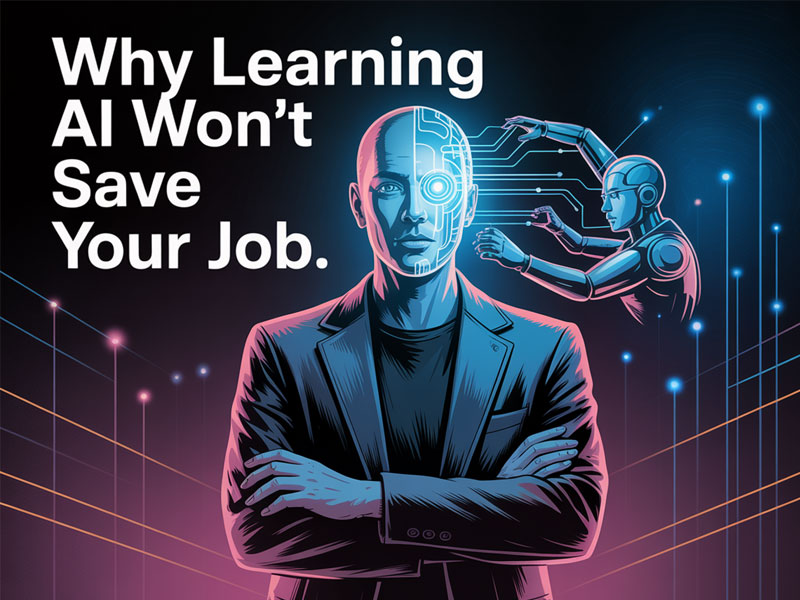
Why Learning AI Won’t Save Your Job (And What Actually Will)
Everyone says “learn AI or get left behind.” They’re wrong!
Learning AI is exactly what’s getting people replaced.
Someone on Reddit put it perfectly:
“Aren’t people who use AI to do their job just training their replacement?”
— Reddit user in r/ArtificialInteligence
Lots of upvotes & comments. People feel it but do not know why.
I was one of them.
I spent 6 months learning every AI tool I could find.
Took courses. Collected prompts. Then I spent $1000 on a super tool and AI system…
Guess what? it was obsolete in less than 60 days!
That’s when I realized that learning tools was probably 30% of what it takes to be good at AI.
You’re Not Crazy for Being Worried

“49 here, been in the insurance industry for 26 years. I don’t know if the technology is quite there yet, but I could totally see being phased out of my position one day by AI. Scares the living shit out of me.”
— Reddit user in r/GenX
You’re not alone. 51% of workers share this exact fear right now.
And unlike most fears, this one is grounded in reality.
The numbers are brutal.
Entry-level positions declined 35% since January 2023.
60% of workers believe AI will cut more jobs than it creates.
Experts keep pointing to 2026-2027 as the critical inflection point.
But here’s what most people miss.
✔️ The fear is valid. ❌ The response is wrong.
When people get scared about AI, they do the obvious thing. They take courses. They learn tools. They collect prompts. It feels productive. It feels safe.
It’s neither.
Why “Learn AI” Is Bad Advice
“My workplace cut the hours of people who create our content with the expectation they can just do more work using AI in less time now.”
— Reddit user in r/ArtificialInteligence
This is the trap. You learn AI. You get faster. Your reward? Less hours. Less pay. Eventually, no job.
Another Reddit user nailed the math:
“If you can finish 40 hours of work in 15, you’re employed 15 hours.”
The data backs this up.
77% of workers want AI training.
Only 25% have received it.
But here’s the part nobody talks about.
Of those who got trained, 23% say AI already made their skills less relevant.
Read that again. People who have learned AI feel MORE replaceable, not less.
That’s because learning AI tools doesn’t protect you.
It proves you’re replaceable.
There’s another problem nobody’s talking about.
When everyone uses the same AI tools with the same prompts, everyone sounds the same.
Mark A. Stafford calls this AI Flattening.
- Your content.
- Your applications.
- Your proposals.
- All blending into one indistinguishable pile.
- You’re not just replaceable.
- You’re invisible.
If the tool can do your job and you just learned to use it, what do they need you for?
This is AI Flattening in action.
It’s Not AI. It’s Your Boss Believing in AI.

“It’s not a matter of ‘is an LLM capable of doing x’ it’s ‘does some corporate dumbass think an LLM is capable of doing it’.”
— Reddit user in r/BetterOffline
This is the most important thing nobody’s talking about.
Another comment from the same thread:
“It doesn’t actually need to be able to do the job. They just have to believe it does. Then they can lay off the people who did it previously.”
Here’s the uncomfortable truth.
MIT released a study showing 95% of enterprise AI initiatives deliver zero ROI.
Ninety-five percent. Nearly every company trying to implement AI is failing.
But they’re cutting jobs anyway.
Why? Because they’re “positioning for disruption.”
They’re making cuts now based on what they think AI will do later.
The AI doesn’t have to work. They just have to believe it will.
You’re not being replaced because AI can do your job. You’re being replaced because you haven’t proven AI can’t do your job.
And every time you use AI to do basic tasks faster, you’re giving them evidence.
What the 5% Do Differently
“How can I use AI to augment my work rather than be replaced by it?”
Finally. The right question.
MIT and Boston Consulting Group studied this exact problem.
They wanted to know why some people thrive with AI while others get replaced.
They found two types of workers who outperform everyone else.
They called them Centaurs and Cyborgs.
Centaurs divide work between human and AI based on who’s better at what.
They consciously choose which tasks go to AI and which stay with them.
Cyborgs go further. They fully blend human and AI thinking in a continuous loop. Every task becomes a collaboration.
The results were significant. 12.2% more tasks completed. 25.1% faster. 40% higher quality work.
These aren’t tool users. They merged their intelligence with AI.
They didn’t learn to use AI. They learned to think with it.
That’s the difference. Tools make you faster. Merging makes you irreplaceable.
What “Intelligence Merging” Actually Means

“I read. I listen. I try to learn. But I don’t reflect like I used to. I’m collecting too much and making too little.”
This is what happens when you consume AI content instead of building AI intelligence.
– You watch videos.
– You read newsletters.
– You follow Twitter threads.
– You feel like you’re learning.
– But nothing compounds.
The Intelligence Merge is the opposite. It’s not learning more. It’s extracting what you already know.
Here’s what that means in plain terms.
You take how you think, how you make decisions, how you communicate, and you teach it to AI.
Not by uploading a few emails. By actually capturing your patterns and frameworks and expertise.
I learned this the hard way.
I spent a month on one prompt.
Then I spent $1000 on a tool and system that became 80% useless in 60 days because something new came out.
That’s when it clicked. Everyone’s chasing tools.
But tools are maybe 30-40% of it.
The other 60-70%? Your intelligence.
And that doesn’t get outdated when the next tool launches.
Think of it this way. Learning AI tools is like learning to use a hammer.
The Intelligence Merge is like becoming an architect who can use any tool.
Want to understand the full methodology?
I wrote a complete breakdown of The Intelligence Merge that explains exactly how extraction works, step by step.
When the next tool comes out, the hammer expert starts over. The architect just picks it up.
Two Paths. Pick One.
Here’s where you are right now. Standing at a fork.
The 95% Path: Learn AI tools. Take courses. Collect prompts. Get faster. Get replaced.
The 5% Path: Extract your expertise. Merge your intelligence with AI. Build something that can’t be copied. Become the person they can’t afford to lose.
The research is clear. 2026-2027 is when it accelerates.
Workers who move from fear to action show better outcomes.
Workers stuck in fear get left behind.
The question isn’t whether AI will change your job. It will.
The question is which path you’re on when it does.
Start the Intelligence Merge (Free)
Here’s where most articles would pitch you a $997 course.
I’m not going to do that.
I built a free AI Clone Foundation Builder inside the Build Don’t Scroll community. It’s 10 modules. Interviews that extract your thinking. Builders that turn it into a working AI clone.
No cost. No catch.
I want 1,000 people to prove this works before I charge for it.
What you get when you join:
- 7 Foundation modules (interviews plus builders)
- 3 Bonus deep personalization modules
- A working AI clone you can test immediately
- A community of people doing the same thing
The community is free right now. Once we hit 100 members, it goes to $9 per month. Early members keep free access.
Join. Build your clone. Stop proving you’re replaceable.
Build, don’t scroll.
Mark A. Stafford is the founder of the Build Don’t Scroll movement and creator of the Intelligence Merge methodology. He runs a one-person digital marketing agency that does the work of 3-4 people with AI, and teaches mid-career professionals how to merge with AI rather than be replaced by it.
Frequently Asked Questions About AI and Job Security
Q: Will AI really take my job?
A: Not directly. But someone who merged their intelligence with AI might. 51% of workers share this fear. The difference is what you do about it. Tool users prove they’re replaceable. Intelligence Merge practitioners prove they’re not.
Q: How soon could AI replace my position?
A: Experts identify 2026-2027 as the critical inflection point. Entry-level positions already declined 35% since 2023. Mid-career roles are next. The window to prepare is now, not someday.
Q: What jobs are most at risk from AI?
A: Any job where you primarily process information, follow procedures, or create content that doesn’t require your unique judgment. Customer service, data entry, basic content writing, and routine analysis are already being hit. The pattern: if AI can do 80% of your tasks, you’re vulnerable. And when your output sounds identical to everyone else’s, you’ve been AI flattened.
Q: Am I too old to adapt to AI?
A: Actually, experience is your advantage. AI was trained on the internet, not on your 15 years of pattern recognition. The more expertise you have, the more valuable your Intelligence Merge becomes. Young people can learn tools fast. They can’t compete with merged intelligence from decades of work.
Q: Are AI courses worth taking?
A: Most aren’t. Research shows 99% of AI courses are lacking or useless. They teach prompts and tools, both of which become obsolete. They create dependency, not competence. The exception: training that teaches you to extract and merge your own intelligence.
Q: What’s wrong with learning AI tools?
A: Nothing, if that’s all you do. Everything, if you think it protects your job. Tools change constantly. The $1000 system that worked last month is 80% useless today. Learning tools puts you on a treadmill. Extracting your intelligence gives you something that compounds.
Q: Why don’t AI certifications protect my job?
A: Because certifications prove you can use tools. Tools are commodities. Anyone can get certified. What companies actually need are people who can think WITH AI, not just USE AI. That’s not something you can certify.
Q: How long does it take to become AI-competent?
A: Wrong question. “AI-competent” usually means tool mastery, which is endless. Intelligence Merge can start in 40 minutes with a structured interview. The foundation takes about a month to build properly. After that, your merged intelligence improves with every use.
Q: What is Intelligence Merge?
A: It’s the process of extracting how you think, decide, and communicate, then merging that with AI capabilities. The complete methodology shows you exactly how this works across five stages. Not uploading documents. Not collecting prompts. Actually capturing your patterns, frameworks, and expertise so AI amplifies YOUR intelligence instead of replacing it.
Q: How is Intelligence Merge different from using AI tools?
A: Tool users ask AI questions and get generic answers. Intelligence Merge practitioners teach AI their thinking and get personalized output. Tool users start over when new tools launch. Intelligence Merge practitioners just upgrade their existing merged intelligence.
Q: What does merging intelligence with AI actually look like?
A: It starts with structured extraction, answering specific questions that capture how you think. Then, synthesis, combining your patterns into custom AI instructions. Then application, using AI as a thinking partner that knows your expertise. The result: AI that sounds like you and thinks with your frameworks.
Q: Do I need technical skills for Intelligence Merge?
A: No. If you can answer questions about your work and thinking, you can extract your intelligence. The methodology does the technical work. You bring the expertise.
Q: Can Intelligence Merge really make me irreplaceable?
A: It makes you significantly harder to replace. Your merged intelligence can’t be replicated by competitors, downloaded by interns, or automated by generic AI. It’s your expertise, amplified. The BCG/MIT research shows workers who merge (Centaurs and Cyborgs) outperform by 40%.
Q: What results do people get from Intelligence Merge?
A: Typical results include 2-3x productivity without working more hours, AI outputs that actually sound like them, and confidence that new AI tools enhance rather than threaten their position. The deeper result: they stop fearing AI and start directing it.
Q: Where do I start with Intelligence Merge?
A: Start with the free Foundation interview. 43 questions. 40 minutes. It extracts 60-70% of your intelligence and gives you a working AI clone you can test immediately. No technical skills required.
Q: What’s the first step to stop being replaceable?
A: Stop proving you’re replaceable. That means stop using AI like a search engine. Start teaching it your thinking. The Foundation interview is designed to begin that process. Link in the description.

Teaching the The Intelligence Merge Methodology.