
The Intelligence Merge
How About 5% of People
Use AI to Become Irreplaceable
“Stop treating AI like an answer vending machine.”
That’s not my advice.
That’s a frustrated Reddit user in 2025, begging others to stop using AI incorrectly.
They’re right. And almost everyone ignores them.
Here’s what I see every day: Someone asks ChatGPT a question.
- Gets a generic answer.
- Asks a slightly different question.
- Gets another generic answer.
- Repeats this for 20 minutes.
- Gives up.
- Says “AI doesn’t work for me.”
That’s not using AI.
That’s using Google with extra steps.

Another user put it perfectly: “We’re not asking for a search engine, we’re losing a thinking partner.”
They know something is wrong. They can feel it.
The tool that was supposed to transform their work just… doesn’t.
It gives them technically correct answers that are practically useless.
It sounds confident while making things up.
It produces content that could have been written by anyone, for anyone, about anything.
And they blame the tool.

But the tool isn’t the problem.
I spent a month on one prompt. Then I spent $1,000 on an AI tool & system that became almost useless in less than 60 days.
I chased every new AI release, every prompt template, every “game-changing” workflow.
None of it worked. Not really. But I knew something was wrong.
Then I accidentally stumbled onto something.
I was trying to wrap my head around Facebook’s Andromeda ad system.
So I found the top YouTube videos explaining it. Pasted the transcripts into Claude. Found Meta’s official article on it. Added that too. Built up all this context.
Then I started brainstorming with Claude.
And the answers didn’t seem right. Something was off.
So I asked: “How can I make this better?”
Claude’s response changed everything: “Tell me how YOU do Facebook ads. We’ll extract what you do and how you do it, and merge it with this.”

That was the moment.
- Not better prompts.
- Not more research.
The missing piece was MY expertise.
- My 15 years of running campaigns.
- My way of thinking about Facebook ads.
Once I extracted that and merged it with the research, suddenly the outputs made sense.
They weren’t generic anymore. They were mine.
That’s when I thought: I think people are using AI wrong.
I think I’ve stumbled onto something here.
I had no idea if anyone else was doing it this way. I just knew it worked.
Turns out, I wasn’t alone.
But I didn’t know that yet.
AI Doesn’t Know You. It Knows the Internet.
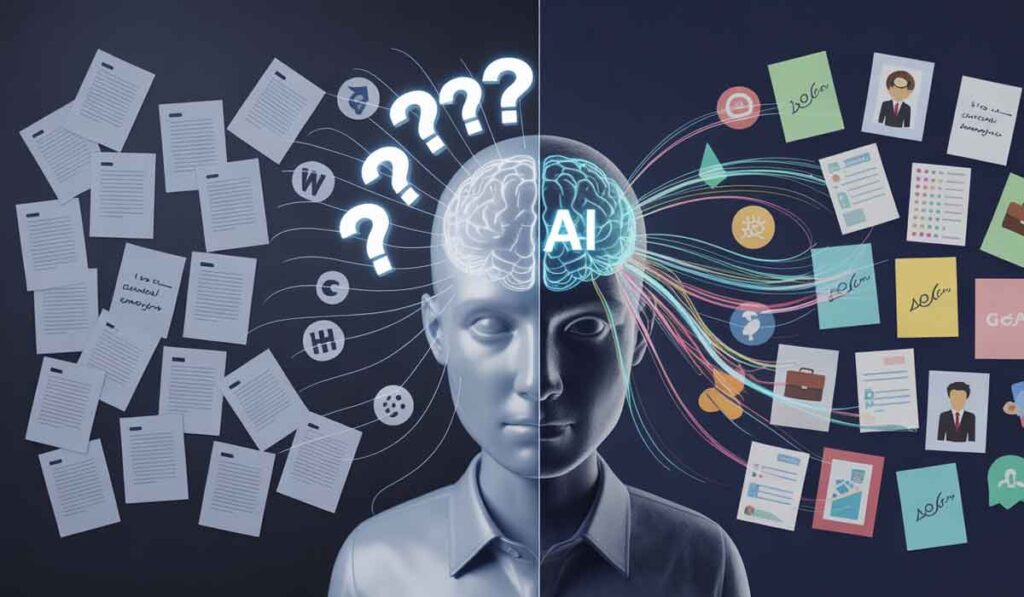
That’s the insight that changes everything.
When you ask AI a cold question, with no context, no background, no teaching, you get internet-average answers.
You get what AI thinks a generic person might want.
You get the statistical middle of everything it was trained on.
- It doesn’t know your industry.
- It doesn’t know your clients.
- It doesn’t know your constraints.
- It doesn’t know your voice.
It’s guessing. And it’s guessing toward the average.
That’s why the outputs feel “off” even when they’re technically correct.
That’s why YOU spend more time fixing AI responses than you would have spent just doing the work yourself.
That’s why 78% of complaints about AI, come from people trying to use it for complex, real-world tasks not simple queries.
You’re not bad at AI.
You’re using it in a way that guarantees mediocre results.
5% of People Use AI Differently. Here’s What They Figured Out.
The research is clear:
95% of people use AI like a search engine.
One question, expect perfect answer.
- No context
- No teaching
- No relationship.
They chase prompts rather than build systems. They HOPE AI knows their situation.
I’m seeing about 5% of people using AI like a thinking partner.
- They teach it their context.
- They create persistent workspaces.
- They extract their expertise into the system.
- They collaborate iteratively.
- They measure and refine.
Same tools.
Different approach.
Opposite results.
The Atlassian study quantified this: People with a “tool mindset” saved 53 minutes per day.
People with a “collaborator mindset” saved 105 minutes per day.
That’s 2x the productivity from the same AI, just used differently.
Harvard Business School found collaborators were 3x more likely to produce breakthrough ideas.
Anthropic’s internal study showed engineers using the collaborative approach got 67% more work done per day.
The gap isn’t about intelligence. It’s not about technical skill. It’s about approach.
The good news? It’s learnable!!!
What the 5% figured out isn’t magic. It’s a methodology.
They treat AI like a new hire that needs onboarding, not an oracle that should already know everything.
One user summarized the pattern perfectly: “Treat AI like a hire into your existing system, not an oracle outside it.”
That’s The Intelligence Merge in one sentence.
Have you been treating AI like an oracle?
Asking questions and hoping for perfect answers?
There’s a better way. And you can learn it.
The Five Mistakes That Keep People in Search Engine Mode

After researching hundreds of Reddit threads, professional case studies, and industry reports from 2025, I found the same patterns over and over.
People aren’t failing because AI is bad.
They’re failing because they’re making the same five mistakes.
If you recognize yourself in any of these, you’re not alone.
Most people make all five.
Mistake #1: Treating AI Like a Magic Answer Machine
One question in, perfect answer out. That’s the expectation.
Reality is different.
“I keep trying different prompts I find online, but ChatGPT still feels like it’s guessing what I want. I waste more time fixing its responses than if I’d just written it myself.”
Sound familiar?
The one-shot approach works for simple queries. “What’s the capital of France?” Perfect.
But the moment you need something specific to your situation, the generic answer falls apart.
AI doesn’t read minds.
It predicts the most likely response based on patterns.
Without your context, it tends to predict toward the average. And the average is useless for real work.
Mistake #2: Expecting AI to Know Your Situation
“Write my Q4 marketing strategy.”
AI produces something.
- It’s structured.
- It sounds professional.
- It’s completely wrong for your business.
Because AI doesn’t know your business. It doesn’t know your budget, your team size, your past campaigns, your competitors, or your customers.
It’s guessing based on what a generic Q4 strategy looks like for a generic company.
“It provides balanced and generic responses rather than reflecting the thought processes of actual investors.”
That’s the gap. AI knows the internet. It doesn’t know you.
Mistake #3: Accepting Output at Face Value
AI sounds confident.
Even when it’s wrong…
“What unsettled me was how certain it sounded… It wasn’t just vague or slightly off. It was confidently quoting things that don’t exist.”
Studies show professionals spend 4.3 hours per week just verifying AI output.
That’s not a productivity gain. That’s a trust tax.
The 5% don’t blindly trust AI.
- They collaborate with it.
- They check.
- They redirect.
- They treat AI like a fast but inexperienced team member who needs supervision, not an expert who knows better than them.
Mistake #4: Chasing Tools Instead of Building Intelligence
New AI tool drops. Everyone rushes to learn it.
Three months later, it’s obsolete or the pricing changes or something better comes out.
I did this myself. I spent $1,000 on a tool that became useless in less than 60 days.
Here’s what I learned:
- Tools are maybe 30-40% of the equation.
- YOUR intelligence is the other 60-70%.
When you chase tools, you build dependency.
When you extract your intelligence, you build an asset that transfers to any tool, current or future.
The people getting real results aren’t tool experts.
They’re experts at merging their thinking with whatever tool they use.
Mistake #5: Giving Up When Features “Don’t Work”
“What’s the point of custom instructions if it just ignores it?”
This complaint appears in 95+ Reddit threads from 2025.
- Custom instructions get ignored.
- Claude Projects seem to forget context.
- Memory features feel broken.
Most people conclude the features are useless and give up.

But here’s what the 5% figured out: These features aren’t “set and forget.” They require active collaboration.
- You have to steer.
- You have to redirect when AI drifts.
- You have to start fresh conversations within your projects.
The features work. But not the way most people expect them to work.
What is The Intelligence Merge?
The Methodology the 5% Use (Whether They Call It That or Not)
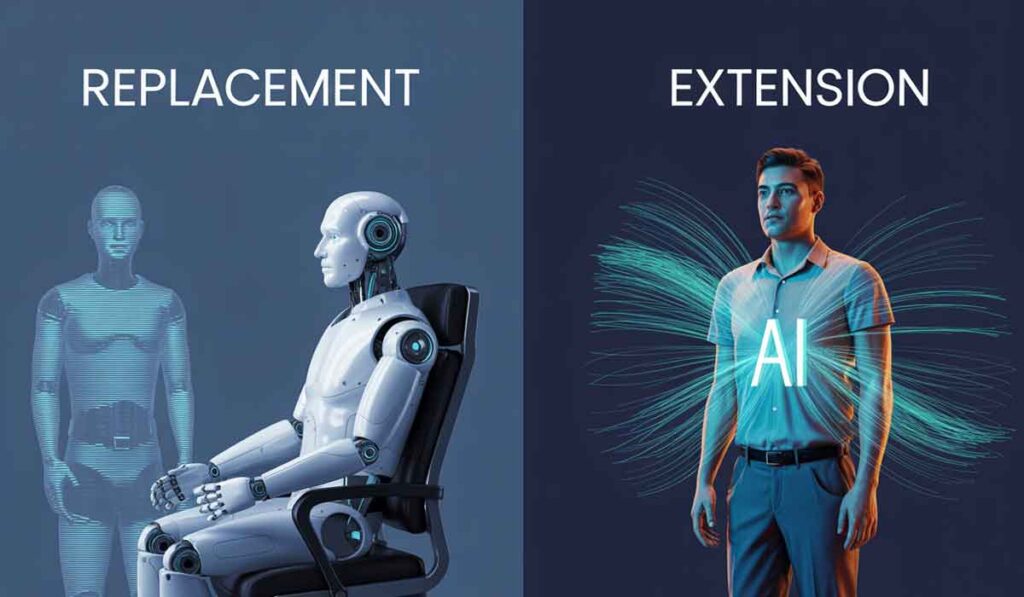
The Intelligence Merge is a systematic methodology for extracting your expertise and merging it with AI capabilities.
Instead of using AI as a replacement for your thinking, you use it as an extension of your thinking.
The result: AI-assisted output that remains distinctly yours, produced at scale.
Let me break that down.
Extraction means capturing what you know that AI doesn’t.
- Your industry expertise.
- Your client insights.
- Your decision-making patterns.
- Your voice.
The things you’ve learned from 5, 10, 15+ years of experience that can’t be Googled.
Merging means teaching that extracted intelligence to AI so it can work alongside you.
Not replacing your judgment. Amplifying it.
The people getting 2x and 3x results figured this out independently.
They’re doing it with CLAUDE.md files, with “Research Brain” custom GPTs, with Gemini Gems loaded with their expertise.”
They just don’t have a name for what they’re doing.
I call it The Intelligence Merge.
The Core Distinction
Replacement: AI does your job. You become replaceable.
Extension: AI amplifies your intelligence. You become irreplaceable.
Same tools. Opposite outcomes. The difference is the approach.
The Mental Model Shift
Old way: “What can AI do for me?”
New way: “What parts of my expertise can I merge with AI?”
That one question changes everything.

The Evidence
Proof That The Intelligence Merge Works
I didn’t invent this approach in a vacuum.
After my own discovery, I started researching whether others had figured out the same thing.
They had. And the results are documented.
The Productivity Data
| Approach | Result | Source |
|---|---|---|
| Tool mindset (generic AI use) | 53 minutes saved per day | Atlassian Study 2025 |
| Collaborator mindset (Intelligence Merge) | 105 minutes saved per day | Atlassian Study 2025 |
| Improvement | 2x productivity |
The same AI. Used differently. Double the results.
As previously mentioned, Harvard Business School research found that collaborators were 3x more likely to produce breakthrough ideas in the top 10%.
Anthropic’s internal study of 132 engineers showed:
- 67% more work output per day
- Productivity boost jumped from +20% to +50%
- 14% of power users reported over 100% productivity gains
Real Professionals, Real Results
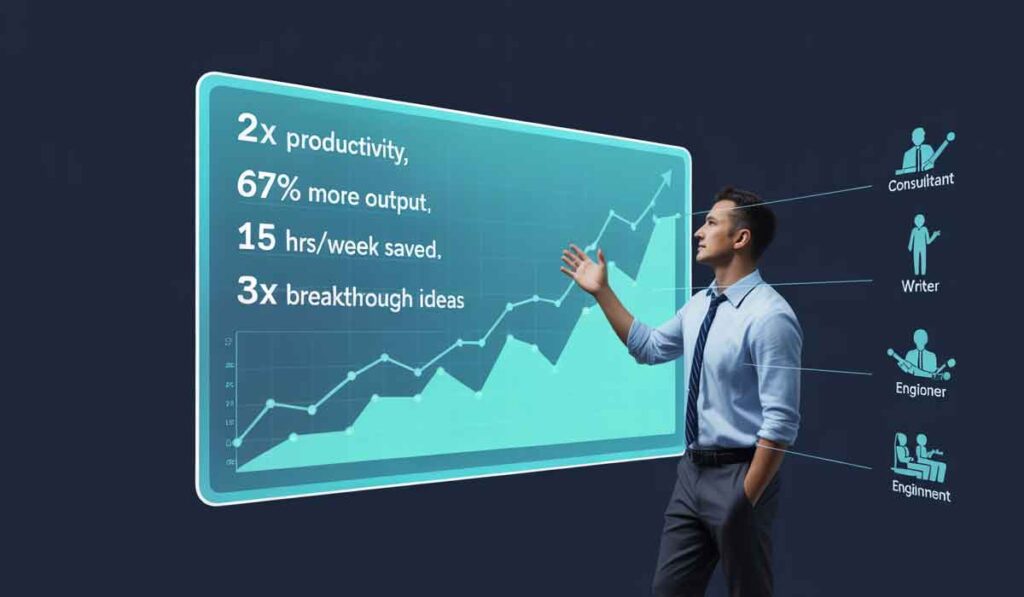
Susan Mernit, Nonprofit Consultant
Built “Research Brain” custom GPTs for each client containing prior grant applications, program descriptions, and impact data.
Result: 15 hours per week saved. 30% faster proposal development.
B2B Content Agency
Built custom GPTs per content format with detailed instructions on tone, structure, and editorial expectations.
Result: Article turnaround dropped from 5 days to 1.5 days. Some content went from outline to publish-ready in 4 hours.
Agency with “Agent Barbara”
Built a GPT trained specifically on one editor’s judgment, learning what she cuts, how she rephrases, and her preferred tone.
Result: “We stopped receiving heavy edits. We weren’t guessing anymore, we were anticipating.”
Anthropic Engineers
Maintain CLAUDE.md files encoding project structure, conventions, testing commands. Treat AI like “a very fast, keen junior developer.”
Result: 67% more merged pull requests per engineer per day.
The Pattern

None of these people called it “The Intelligence Merge.”
But they all did the same thing:
- Extracted their expertise into artifacts AI could use
- Created persistent workspaces with accumulated context
- Collaborated iteratively instead of expecting one-shot perfection
- Measured results and refined their systems
They figured it out independently. The methodology is the same.
5 Shifts That Separate the 5% from Everyone Else
You’ve seen the evidence. Now here’s how to actually do it.
These work across any platform. ChatGPT, Claude, Gemini. The methodology is the same.
Pattern #1: Load Context Before You Ask for Anything
Don’t start with your question. Start with your situation.
Before you ask AI to write your marketing strategy, tell it about your business. Your budget. Your team size. Your past campaigns. What worked. What flopped.
Before you ask for help with a client proposal, upload previous proposals. Share what this specific client cares about. Explain the relationship history.
The more context you load upfront, the less generic the output.
Think of it like briefing a new contractor.
You wouldn’t hand them a task and walk away.
You’d give them background first. Do the same with AI.

Pattern #2: Build a Home Base
Stop starting from scratch every conversation.
Create a dedicated workspace for your most important use cases. A project for client work. A custom assistant for content creation. A gem for your specific expertise area.
Load it once with your context, your preferences, your examples of good work. Then every conversation starts from that foundation instead of zero.
The 40 minutes you spend setting this up saves you hours of re-explaining yourself over and over.
Pattern #3: Work With It, Not At It
One prompt, perfect output. That’s the fantasy.
Reality: You’ll get something close. Then you refine it. Then you push back. Then it gets better.
This isn’t a flaw. This is how it works.
Ask for a first draft. Review it. Tell AI what’s off. Ask for another pass. Repeat until it’s right.
The people getting great results aren’t writing magic prompts. They’re having conversations. They’re steering. They’re collaborating.
If you’re frustrated that AI doesn’t nail it on the first try, you’re expecting the wrong thing.
Pattern #4: Know What to Hand Over and What to Keep
AI is fast at some things. Terrible at others.
Hand over: First drafts. Research synthesis. Formatting. Repetitive tasks. Brainstorming options. Turning rough notes into clean prose.
Keep for yourself: Final judgment. Strategic decisions. Anything high-stakes. Anything requiring taste. The last 10% that makes it yours.
The goal isn’t to hand over everything. It’s to hand over the right things so you can focus on what actually requires your brain.
Pattern #5: Extract Before You Execute
This is the one that changes everything.
Before you use AI for a task, ask yourself: What do I know about this that AI doesn’t?
Then tell it.
- Your process.
- Your preferences.
- Your shortcuts.
- Your rules of thumb.
- The things you’ve learned the hard way over years of doing this work.
Don’t assume AI will figure it out. Don’t hope your expertise will somehow transfer through osmosis. Explicitly extract what’s in your head and put it into the system.
That extracted intelligence is what turns generic AI into YOUR AI.

Why It Works
Why “Set It and Forget It” Fails (And What Actually Works)
If the methodology is so effective, why do so many people give up on AI personalization features?
Because they expect them to work like magic. They don’t.
The Reliability Problem
As mentioned earlier, “What’s the point of custom instructions if it just ignores it?”
- This complaint appears constantly.
- Custom instructions get ignored.
- Projects seem to forget context.
- Memory features feel broken.
Here’s what’s actually happening:
AI models are trained through Reinforcement Learning from Human Feedback (RLHF) to be “helpful, agreeable, and non-threatening.”
In practice, this means AI will add context “just to be helpful” even when you said not to.
It will reformat your output “to make it clearer” even when you specified a format.
Your custom instructions sit at the bottom of the priority stack.
When they conflict with AI’s training to be helpful, the training often wins.
The Context Window Problem
Even when instructions work initially, they can fade.
“Extended discussions tend to falter, leading to a decline in the quality of responses as time goes on.”
As conversations get longer, your instructions get pushed out of the active context window.
By response five or six, AI starts drifting back to generic patterns.
Why The Intelligence Merge Works Anyway
The methodology compensates for these AI design limitations.
Active steering, not passive setup. You don’t set instructions and walk away.
You tell AI what’s coming next. You redirect when it drifts.
That overrides the “be helpful” defaults in real-time.
Fresh chats within persistent projects. Your Project Knowledge or Custom GPT stays stable.
It doesn’t get pushed out.
But you start fresh conversations within that container, so you get a clean context window every time.
You read everything. Most users accept outputs blindly.
When you actually review what AI produces, you catch drift immediately.
Supervision plus AI capability equals reliable results.
You think more, not less.

Using the methodology forces me to think 5-10x more than working alone.
You’re not outsourcing your brain.
You’re using AI to amplify your thinking.
This is why the 5% don’t complain about features being broken.
They’re not relying on features to work automatically. They’re actively collaborating.
How to Start The Intelligence Merge
The First Step
You don’t need to master everything at once.
The Intelligence Merge starts with one question:
What do you know that AI doesn’t?
Think about it.
- Your industry constraints that AI can’t see.
- Your client preferences that AI can’t guess.
- Your decision-making patterns that AI can’t replicate.
- Your voice that AI can’t imitate.
That’s YOUR intelligence.
That’s what makes you valuable. And that’s exactly what you need to extract and merge with AI.
The AI Clone Foundation
I’ve built a free starting point.
43 questions designed to extract your unique thinking.
Takes about 60-120 minutes and creates an immediate 50-6% intelligence match.
No technical skills required. If you can talk about your work, you can complete it.
The questions capture how you think, how you make decisions, how you communicate, and what you know from your years of experience.
Once extracted, that intelligence can be loaded into Claude Projects, Custom GPTs, or Gemini Gems.
Any platform.
Your intelligence is the asset.
The tool is just the container.
Frequently Asked Questions About The Intelligence Merge
What is The Intelligence Merge?
The Intelligence Merge is a systematic methodology for extracting your expertise and merging it with AI capabilities. Instead of using AI as a replacement for your thinking, you use it as an extension. The result is AI-assisted output that remains distinctly yours, produced at scale. The term was coined by Mark A. Stafford of Build Don’t Scroll.
Is this just “better prompting”?
No. Prompting is asking AI better questions. The Intelligence Merge is teaching AI your context, expertise, and thinking patterns before you ask anything. It’s the difference between asking a stranger for advice and asking a trained colleague who knows your situation.
How is this different from Custom Instructions or Custom GPTs?
Custom Instructions, Custom GPTs, Claude Projects, and Gemini Gems are tools. The Intelligence Merge is a methodology for using those tools effectively. Most people who try these features give up because they don’t know what to put in them. The methodology solves that problem.
Do I need technical skills?
No. The Intelligence Merge uses voice-based interviews and guided extraction. If you can talk about your work, you can complete the process.
How long does it take?
The Stage 0 Foundation takes about 40 minutes. Building a complete system takes 2-3 weeks of focused work. Most people start seeing results within the first week.
Does this work for any profession?
Yes. The methodology has been used by consultants, writers, marketers, developers, executives, and educators. Any profession with accumulated expertise can benefit.
What if AI keeps ignoring my instructions?
This is addressed in the methodology. The Intelligence Merge doesn’t rely on “set and forget” instructions. It teaches iterative collaboration where you actively steer conversations and use fresh chats within persistent projects. This compensates for the design limitations that cause instruction drift.
How is this different from other AI training?
Most AI training teaches tools and prompts. The Intelligence Merge teaches methodology. Tools become obsolete. Prompts stop working. Your extracted intelligence transfers to any AI system, whether it’s ChatGPT, Claude, Gemini, or whatever comes next.
What results can I expect?
Research shows professionals using this approach achieve 2x productivity gains compared to generic AI use. Case studies document 15+ hours per week saved, 30% faster deliverables, and eliminated revision cycles.
What is AI Flattening and how does this relate?
AI Flattening is what happens when everyone uses AI as a replacement instead of an extension. All outputs converge toward generic sameness. The Intelligence Merge is the solution. It’s how you use AI without getting flattened.
Your Next Step
You’ve seen the data.
95% of people use AI like a search engine and wonder why it doesn’t work.
5% use AI differently.
- They teach it their context.
- They extract their expertise.
- They collaborate iteratively.
- And they get 2x the results.
The difference isn’t talent. It’s not technical skill.
It’s methodology. And you can learn it.
The Intelligence Merge gives you the system.
The AI Clone Foundation gets you to 50% – 60% intelligence match in your AI of choice.
Plus, I’m giving you the full version of my new book, “Cloned,” absolutely free.
People who are reading at least halfway through the book before starting to build their AI foundational clone are grasping the concepts 10 times better.
Come join an awesome community of like-minded people who want to break free from generic AI!