
AI Flattening
Why Everyone Sounds the Same Now
(And How to Escape)
The LinkedIn Experiment
I recently searched for six words on LinkedIn… and what I found was embarrassing.
The search: “In today’s fast-paced world.”
The results: Hundreds of profiles. (Maybe even thousands?)
Nearly identical language.
The same phrases are repeated over and over.
“Results-driven.” “Pivoting Strategies.” “Proven track record.” “Passionate about delivering value.” “Adapting new technologies.”
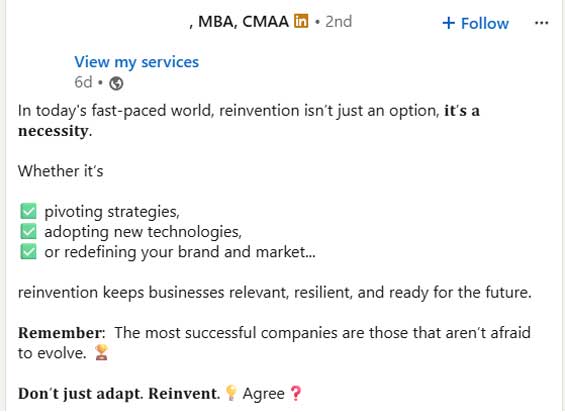
Every profile sounded like it was written by the same person.
Because it was. Sort of.
These weren’t lazy people.
They were smart professionals trying to stand out in a competitive job market.
They used the most powerful writing tool available to them.
You guessed it… They asked AI to help them sound more professional.
And now they all sound the same.
Here’s the thing nobody talks about: everyone says AI makes you more productive.
They’re half right. It also makes you invisible.
There’s a name for what’s happening.
There’s research proving it’s real. And there’s a way to escape it.
Have you noticed this too?
That creeping feeling that everything online sounds… the same?
What is AI Flattening?
AI Flattening is what happens when everyone uses AI as a replacement instead of an extension of themselves.
When millions of people feed the same prompts into the same tools, all outputs converge toward generic sameness.
Distinction disappears. Uniqueness compresses.
The market “flattens,” and everyone becomes invisible.
Think of it like a crowd where everyone wears the same outfit.
You wouldn’t stand out. You’d blend in.
That’s what’s happening to content, applications, proposals, emails, and communications across every industry.
Not because people are lazy. Because they’re all using AI the same way.
Here’s the split I keep seeing:
~95% use AI as a replacement. They paste prompts, accept outputs, and publish. They get flattened.
~5% use AI as an extension. They’ve trained an AI on their unique way of thinking. They stand out more than ever.
- The tool is the same.
- The approach is different.
- The results are opposite.
“AI Flattening is the great equalizer, but not in a good way. It equalizes everyone toward mediocrity.”

The Evidence is Overwhelming
I didn’t coin this term because I had a hunch.
I coined it because the research is undeniable.
They Can Spot You
Let’s start with detection rates.
According to Hookline’s 2025 AI in Content Marketing Report, 82.1% of Americans can spot AI-written content at least some of the time.
Among people aged 22-34, that number jumps to 88.4%.
Only 11.6% of young people say they never notice AI content.
Read that again.
Nearly 9 out of 10 young professionals can tell when something was written by AI.
We’re not fooling anyone.
They’re Rejecting Us
Now let’s talk about what happens when they spot it.
TopResume surveyed 600 U.S. hiring managers. The findings:
- 19.6% automatically reject candidates with AI-generated resumes or cover letters
- 33.5% can spot an AI resume in under 20 seconds
- 25% believe cover letters should remain completely AI-free
One career consultant, Shoshana Davis, shared a story that stuck with me.
An employer received about 100 responses to a question asking candidates to describe their favorite product launch.
Nearly all of them cited Peloton. Word for word. The same answer.
The employer immediately knew it was ChatGPT, and the campaign they referenced was several years old.
One hundred people. Same answer. All rejected.
Laurie Chamberlin, Head of LHH Recruitment Solutions North America, put it bluntly:
“A good recruiter can spot AI-written resumes from a mile away. Resumes produced by AI often adhere to a similar format, employ excessively formal or ambiguous language, and lack the personal insights that authentic human experiences contribute.”
Sound familiar?
Maybe you’ve sent applications like this. Maybe you’ve received them.
The Platforms Are Punishing Us
It’s not just recruiters. The algorithms have caught on too.
Data from 2025 shows that over 50% of LinkedIn posts are now AI-assisted.
LinkedIn’s response? Algorithmic punishment.
AI-generated content receives 30% less reach and 55% less engagement compared to human-written posts.
The platform now detects AI content with 94% accuracy.
Let that sink in…
You’re using AI to save time on content creation, but your content is reaching half as many people and getting half the engagement.
The time you saved? You’re paying for it in invisibility.
The Sameness is Measurable
Researchers have actually quantified this.
A study published in ScienceDirect compared human-generated essays with GPT-4-generated output.
Human essays scored 8.95 points higher on a Diversity Score Index.
When they measured how diversity scales with volume, human writing showed a growth rate of 0.58 compared to GPT-4’s 0.18.
Translation: each additional AI essay contributes only 31% of the new ideas that a human essay would contribute.
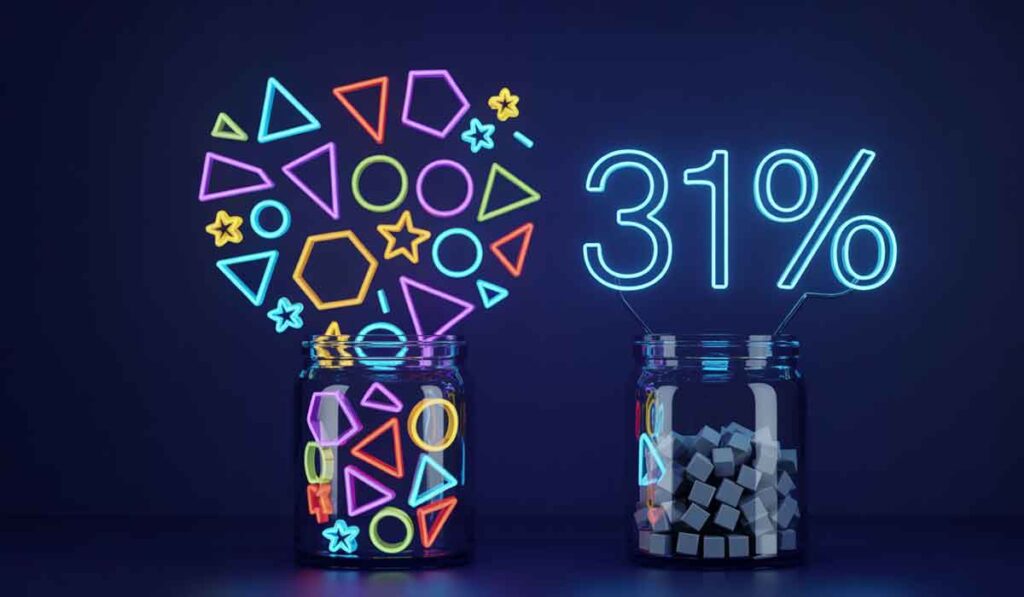
The more AI content enters the ecosystem, the more homogeneous everything becomes.
University of California, Berkeley researchers found that AI models released after 2022 are 20-30% more alike than earlier versions.
They called this convergence an “artificial hivemind.“
Stefan Maritz captured what this means for businesses:
“Internal decks sound off. Sales emails feel templated. Social posts read like they were generated in 10 seconds. This is what happens when everyone on your team uses personal ChatGPT accounts to create content. No rules. No training. No context. You’ve lost control of your tone of voice, one of the few things that actually makes your brand recognizable.”
THE FLATTENING BY THE NUMBERS
| Metric | Finding |
|---|---|
| Detection rate | 82% of Americans can spot AI content |
| Engagement penalty | 55% less engagement on AI LinkedIn posts |
| Auto-rejection rate | 19.6% of recruiters reject AI applications |
| Diversity gap | AI contributes only 31% of human writing diversity |
| Model convergence | 20-30% more alike since 2022 |
Why AI Flattening Happens
This isn’t a bug. It’s the design.
The Prediction Problem
AI doesn’t create. It predicts.
Every AI writing tool calculates the most statistically likely next word based on patterns in its training data.
Feed it a prompt, and it produces the most probable response.
The response that would satisfy the widest possible audience.
Think of AI like a chef who only cooks the most popular dish.
Ask for a meal, and you get the dish that satisfies the most people.
It’s not bad. It’s just what everyone else is eating.
The Training Data Overlap
Here’s why all AI sounds similar regardless of which tool you use: they all trained on the same internet.
ChatGPT, Claude, Gemini, and every other major model scraped the same sources.
- Reddit.
- Wikipedia.
- Twitter.
- News sites.
- Same input, same output patterns.
Different companies built them, but they share the same foundation.
Thus, Individual models lose their distinctiveness in favor of group consensus.
The outputs converge.
The “Delve” Mystery
Florida State University researchers discovered something strange.
They identified 21 words whose frequency in writing spiked dramatically after ChatGPT launched, with no obvious explanation.
Words like “delve,” “navigate,” “realm,” “tapestry,” and “underscore.”
These words now appear more often in spontaneous human conversation too.
A Max Planck Institute study analyzed over 360,000 YouTube videos and 771,000 podcast episodes before and after ChatGPT’s release.
The result: people started saying “delve” more in unscripted speech.
We’re unconsciously adopting AI’s vocabulary.
Adam Aleksic explained this in his December 2025 TED Talk:
“Multiple studies have found that, since ChatGPT came out, people everywhere have been saying the word ‘delve’ more in spontaneous spoken conversation… We’re subconsciously confusing the AI version of language with actual language… We’re in a positive feedback loop with the AI representing reality, us thinking that’s the real reality, and regurgitating it so the AI can be fed more of our data.”
Have you caught yourself using these words more?
I have. It’s subtle, but it’s happening.
The RLHF Effect
There’s one more piece to this puzzle.
After initial training, AI models go through a fine-tuning process where human annotators evaluate outputs and provide feedback.
This is called Reinforcement Learning from Human Feedback, or RLHF.
Many of these annotators were based in Kenya and worked for low wages.
Their linguistic preferences got embedded in the model. “Delve” was common in their vocabulary.
Now it’s common in everyone’s.
The AI doesn’t just reflect the internet. It reflects the specific preferences of the people who fine-tuned it.
WORDS THAT SIGNAL “AI WROTE THIS”
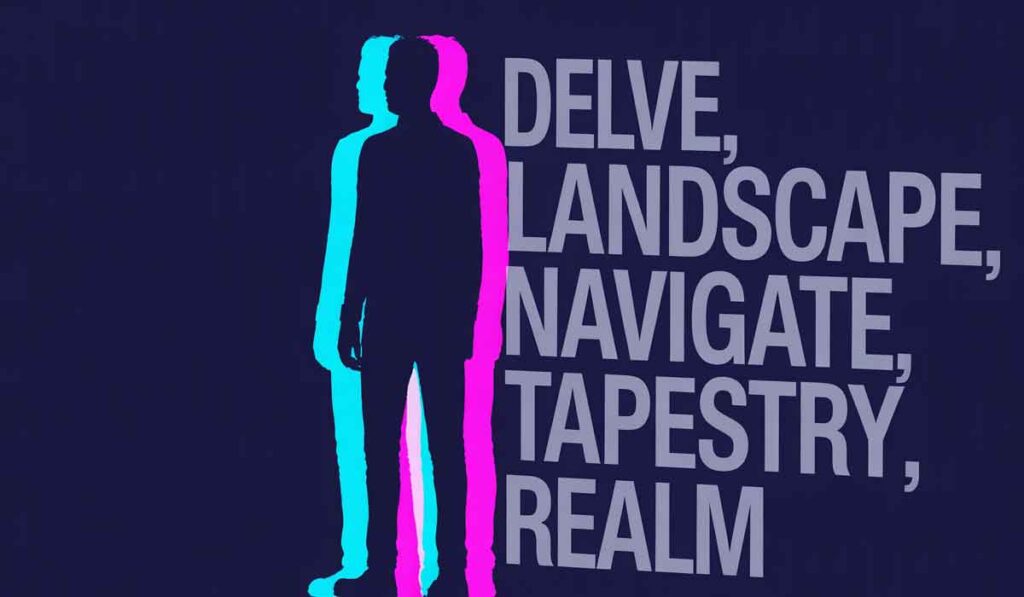
- delve, dive, navigate
- realm, tapestry, landscape
- foster, underscore, harness
- pivotal, profound, palpable
- revolutionize, transformative, game-changing
- “In the ever-evolving landscape of…”
- “It’s a testament to…”
- “Navigate the complexities of…”
If you’re using these words frequently, you might already be flattened.
What AI Flattening is Costing You
The costs are different depending on who you are. But they’re real for everyone.

If You’re a Job Seeker
- Your application looks like everyone else’s.
- Recruiters are auto-rejecting before they finish reading.
- You’re competing on sameness rather than on strengths.
The cruel irony: the more you use AI to “stand out,” the more you blend in.
Bill Franks, a Chief Analytics Officer, said it directly:
“AI-generated cover letters are overly glowing and contain a lot of buzzwords and just don’t read as authentic. It tells me NOTHING about how the person would write or why they want the job.”
You’re not showing them you.
You’re showing them what AI thinks a good candidate sounds like.
And so is everyone else.
If You’re Building a Brand
The trust damage is measurable.
Research shows 50.1% of people think less of writers who use AI. 40.4% think less of brands that use AI.
Lower engagement means higher customer acquisition costs.
Generic messaging doesn’t convert.
When your marketing sounds like everyone else’s marketing, you end up competing on price instead of preference.
One analysis from CXL described it perfectly:
“Your brand voice is disappearing. Not all at once, but bit by bit. An email here, a post there, a proposal shaped by a chatbot. It happens so gradually you barely notice… Each AI-assisted email, deck, and post introduces slight deviations from brand voice. Collectively, they erode trust, weaken differentiation, and turn brands into commodities.”
If You’re a Creator
- Your distinctive voice is your most valuable asset.
- It’s what makes people follow you instead of someone else.
- It’s what makes your work recognizable.
AI smooths out the edges that make you memorable.
One LinkedIn user confessed something that haunts me:
“What really scares me is how much I’ve started to sound like ChatGPT, even when I’m writing on my own. I guess my writing has improved over the years with Chat’s help, but probably also become more generic.”
That’s the hidden cost.
You’re not just producing generic content. You’re training yourself to think generically.
The Invisible Tax
Every AI-assisted email. Every AI-drafted post. Every AI-generated proposal.
Each one is slightly less “you” than the last.
Collectively, they erode your distinctiveness.
- Until there’s nothing left to recognize.
- Until you’re just another gray figure in the crowd.
Maybe that’s you, right?
Using AI to save time, but slowly losing what makes your work yours?
THE AI FLATTENING SPECTRUM
FLATTENED ←―――――――――――――――――――――――→ DISTINCT
Generic prompts Extracted expertise
Copy-paste outputs Personalized collaboration
Sounds like everyone Sounds like you, amplified
Replaceable Irreplaceable
Where are you on this spectrum?
Are You Being Flattened?
Here’s a quick test. Be honest with yourself.
Signs of AI Flattening:
- You paste prompts into ChatGPT without customization
- Your outputs sound “professional” but not like you
- You use AI words like “delve,” “landscape,” “navigate” without noticing
- Your content could have been written by anyone in your industry
- You’ve received feedback that your writing sounds “generic” or “templated”
- You struggle to remember what your voice sounded like before AI
- Your engagement rates have dropped despite posting more
- You use AI as a shortcut, not a thinking partner
How to read your results:
1-2 checked: Early stage. Awareness is your advantage. You can course-correct now.
3-5 checked: Mid-stage. Your voice is fading. The people who matter are starting to tune you out.
6+ checked: Advanced. You’re already invisible to the people you’re trying to reach… Sorry!
This isn’t about shame.
I checked several of these boxes myself before I figured out what was happening.
The question isn’t whether you’ve been flattened. The question is what you do next.
The good news?
There’s a way out.
And it doesn’t mean abandoning AI.
The Way Out: From Flattened to Distinct

Most people think the options are:
- Use AI and sound generic
- Avoid AI and fall behind
Wrong. There’s a third option.
The problem isn’t AI.
The problem is using AI as a replacement.
The solution is using AI as an extension.
Here’s the difference:
The Replacement Approach:
- “Write me a cover letter”
- “Create a LinkedIn post about X”
- “Draft an email to my client”
Result: AI’s voice. Generic. Flattened.
The Extension Approach:
- AI knows how YOU think
- AI knows YOUR frameworks
- AI knows YOUR voice patterns
- AI knows YOUR decision-making style
Result: Your voice, amplified. Distinct. Irreplaceable.
I call this approach The Intelligence Merge.
It’s a systematic way to extract your expertise and merge it with AI capabilities.
Instead of AI replacing your thinking, AI extends your thinking.
The outputs are still distinctly yours.
But now you can produce them at scale.
How I Discovered This
I spent a month on one prompt.
Then I spent $1,000 on an AI tool/system that became useless in 60 days.
That’s when it clicked: everyone’s chasing tools, but tools are maybe 30-40% of it.
The other 60-70%? YOUR intelligence.
So I stopped learning tools and started extracting my thinking patterns into AI.
The result?
I built a system to handle Google reviews for a client.
Not just any system.
A system trained on how that specific business thinks, responds, and communicates.
12,000+ reviews handled. Still running 24 months later.
Not because the tool was special.
Dozens of review response tools exist.
This one worked because MY thinking was embedded in it along with the business owner’s voice. Their values. Their way of handling complaints.
That’s the difference between replacement and extension.
The Core Insight
AI doesn’t know you! It knows the internet.
When you use AI as a replacement, you get internet-average outputs.
When you use AI as an extension, you get YOUR outputs at internet speed.
Your intelligence is the asset. AI is just the amplifier.
If you want to understand exactly how this works, I’ve written an easy to read book called “Cloned,” which will be on Amazon soon…
However, you can get it free, along with the foundational AI clone setup system, in my Skool community .
You’ll implement the Intelligence Merge methodology Along with all the other people in little group.
I guarantee it’s the antidote to AI Flattening!
Frequently Asked Questions About AI Flattening
What is AI Flattening?
AI Flattening is the phenomenon where widespread use of AI writing tools causes all content to converge toward generic sameness. When millions of people use the same AI tools with similar prompts, outputs become indistinguishable. Distinction disappears, uniqueness compresses, and everyone becomes invisible. The term was coined by Mark A. Stafford of Build Don’t Scroll to describe this documented but previously unnamed phenomenon.
Why is it called “flattening”?
The metaphor refers to compression and loss of dimension. Just as a 3D object “flattened” into 2D loses depth and distinctiveness, AI-assisted content “flattened” through generic use loses the qualities that make it memorable and recognizable. The market becomes flat, with no peaks of distinction to stand out from.
Is AI Flattening the same as AI-generated content?
Not exactly. AI Flattening specifically describes the homogenization effect when AI is used as a replacement rather than an extension. You can use AI extensively without being flattened, but only if you’ve trained it on your unique thinking patterns, voice, and expertise. The approach matters more than whether you use the tool.
How do people detect AI-generated content?
Research shows 82.1% of Americans can spot AI content at least some of the time. Common detection signals include: overuse of words like “delve,” “landscape,” and “navigate”; predictable three-point structures; excessive hedging language like “arguably” and “to some extent”; perfect grammar paired with zero personality; and the absence of specific personal examples, anecdotes, or distinctive opinions.
Do hiring managers really reject AI applications?
Yes. TopResume research found 19.6% of recruiters automatically reject AI-generated resumes and cover letters. Additionally, 33.5% can identify an AI resume in under 20 seconds. Documented cases include employers receiving dozens of identical responses to the same question, making AI-assisted applicants immediately obvious and easily dismissed.
Does AI content actually perform worse?
Significantly. LinkedIn data shows AI-assisted posts receive 30% less reach and 55% less engagement compared to human-written content. The platform detects AI content with 94% accuracy and algorithmically deprioritizes it. Similar patterns are emerging across other platforms as detection technology improves.
Why does all AI content sound the same?
AI models predict the most statistically likely next word based on training data. All major models trained on similar internet sources, including Reddit, Wikipedia, and news sites, creating overlapping patterns. The result is regression toward the statistical mean, producing “average” outputs designed to satisfy the widest possible audience but stand out to no one.
What are the “AI words” that give it away?
Commonly overused AI words include: delve, dive, navigate, realm, tapestry, landscape, foster, underscore, harness, pivotal, profound, palpable, and transformative. Phrases like “in the ever-evolving landscape of,” “it’s a testament to,” and “navigate the complexities of” are also strong indicators of AI-generated or heavily AI-assisted content.
How does AI Flattening affect job seekers?
Job seekers using generic AI for applications face higher rejection rates, longer job searches, and reduced interview callbacks. When your application sounds identical to hundreds of others using the same tools and prompts, you’re competing on sameness rather than strengths. The tool meant to help you stand out actively makes you blend in.
How does AI Flattening affect businesses?
Businesses experience brand voice erosion, decreased engagement, reduced audience trust, and higher customer acquisition costs. When all marketing sounds the same, brands lose their distinctive positioning and competitive advantage. They end up competing on price instead of preference, eroding margins and commoditizing their offerings.
Can I use AI without being flattened?
Yes. The key is using AI as an extension of your unique intelligence rather than a replacement for it. This requires systematically extracting your expertise, frameworks, decision-making patterns, and voice into AI before using it for content creation. The methodology for doing this effectively is called The Intelligence Merge.
What is The Intelligence Merge?
The Intelligence Merge is a systematic methodology developed by Mark A. Stafford for extracting your expertise and merging it with AI capabilities. Instead of using generic AI that sounds like everyone else, you train AI on how YOU think, decide, and communicate. The result is AI-assisted output that remains distinctly yours, produced at scale without sacrificing authenticity or distinction.
Your next step?
Build Don’t Scroll & make yourself irreplicable by joining our Skool community.
Mark A. Stafford