

I Searched 6 Words on LinkedIn. The Results Were Embarrassing.
I searched six words on LinkedIn. Just six words.
What I found was embarrassing. Not for me. For the people posting.
Four different professionals. Four different industries. All starting their posts with the exact same phrase. Same opener. Same structure. Same nothing.
That’s when I realized: AI isn’t just making content generic…
It’s flattening everyone into the same voice.
Let me show you what I found, why it happens, and what actually fixes it.
The Six Words
The phrase I searched: “In today’s fast-paced world.”
I typed it into LinkedIn’s search bar and watched the results roll in.
Post after post after post.
All starting with some variation of those six words.
Here are four I found within minutes.
Please note I’m not shaming anybody just pointing out the obvious usage of generic AI.
Exhibit A: The M&A Professional
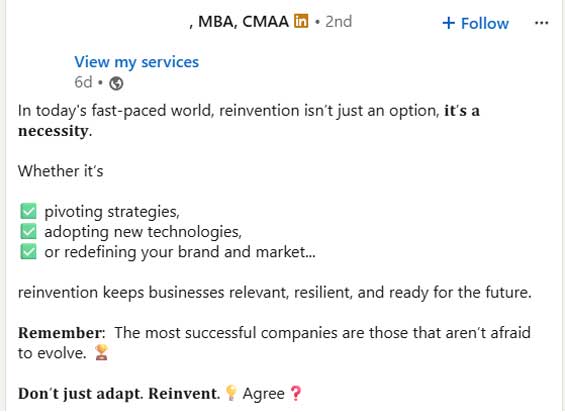
An M&A advisor. MBA. Credentials. Runs a practice helping companies through mergers and acquisitions.
Their post: “In today’s fast-paced world, reinvention isn’t just an option, it’s a necessity.”
Then a checkbox list of generic advice. Pivoting strategies. Adopting new technologies. Redefining your brand.
Nothing about a deal they actually worked on.
No story about a company that reinvented and won.
No reason to believe this person knows anything about reinvention beyond what anyone could say.
Exhibit B: The Talent Manager
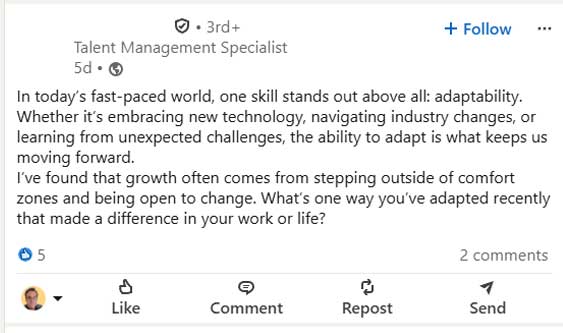
A talent management specialist.
Works with people for a living.
Probably has dozens of stories about candidates who adapted and succeeded, or didn’t and failed.
Their post: “In today’s fast-paced world, one skill stands out above all: adaptability.”
Same opener. Different word at the end. Same structure. Same nothing.
This person talks to humans every day.
They have real stories.
But instead of sharing one, they posted this.
Exhibit C: The Cybersecurity CEO
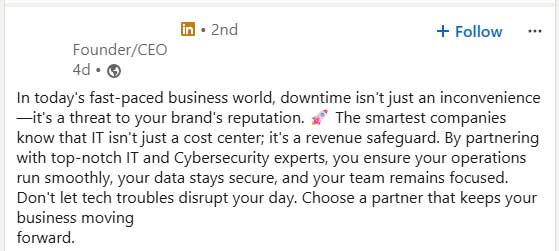
A founder and CEO of a technology company. “Enabling Growth With Technology” in their title.
Their post: “In today’s fast-paced business world, downtime isn’t just an inconvenience, it’s a threat to your brand’s reputation.”
Notice the tiny variation? “Business world” instead of just “world,” and the Em-dash is a solid AI giveaway.
Same template. Slightly different fill-in-the-blank.
This is a CEO.
They could share war stories about security breaches they prevented.
Clients they saved. Lessons from the trenches.
Instead: template.
Exhibit D: The Software Marketer
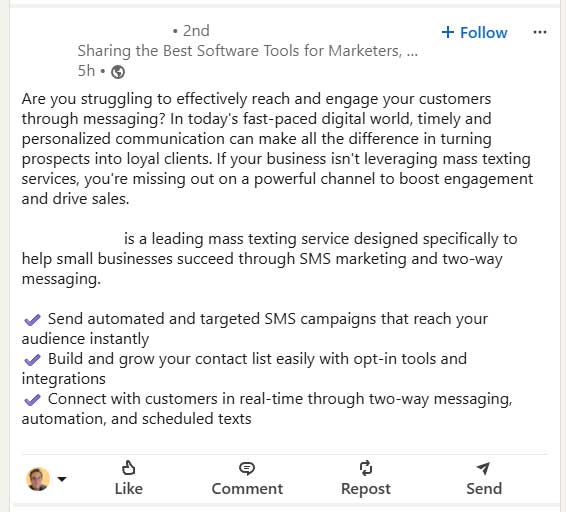
A software marketer. Their whole job is helping businesses stand out with better communication.
Their post: “In today’s fast-paced digital world, timely and personalized communication can make all the difference.”
“Digital world” this time.
Same structure. Same checkbox list. Same generic advice.
The irony?
This person markets communication tools.
And their communication sounds exactly like everyone else’s.
The Pattern Nobody’s Talking About

Four people. Four industries.
M&A. Talent management. Cybersecurity. Software marketing.
All starting with the same phrase.
All using the same structure.
All saying nothing specific to their actual experience.
This isn’t a coincidence. This is a pattern.
I call it AI Flattening.
AI Is Flattening Your Voice

Your expertise. Your experience. Your perspective. Your years of doing the actual work.
All compressed into “In today’s fast-paced world.”
- The M&A advisor has done real deals. Flattened.
- The talent manager has seen real careers. Flattened.
- The CEO has fought real security battles. Flattened.
- The marketer has run real campaigns. Flattened.
All that knowledge, all that perspective, squeezed through AI and turned into the same generic voice as everyone else.
You’ve seen posts like this.
You’ve scrolled past dozens of them.
Maybe you’ve written one yourself.
No judgment.
But now you can name what’s happening. It’s flattening.
Why This Happens
Here’s the simple explanation: AI doesn’t know you.
AI is trained on the internet. It knows how millions of people write.
It’s absorbed countless LinkedIn posts, blog articles, business documents.
When you ask AI to write something, it gives you the average of everyone.
That’s why the M&A advisor sounds like the talent manager, who sounds like the CEO, who sounds like the marketer.
They’re all getting the same “average professional voice” because none of them taught AI their specific voice first.
The input was generic. So the output was generic.
AI doesn’t know that you spent 15 years doing M&A deals.
It doesn’t know the client who almost walked away until you found a creative structure.
It doesn’t know your valuation philosophy.
It just knows “professional LinkedIn post about business change.” And it gives you exactly that.
The Paul Revere Problem
Let me give you an analogy that makes this concrete.
Imagine 30 middle school kids. All given the same assignment: write a report on Paul Revere’s ride. One if by land, two if by sea.
Now imagine they all use the same AI tool to help them write.
What happens?
80% of those reports sound nearly identical. Not because the kids cheated. Not because they’re lazy. But because the AI flattened all of them into the same voice.
Think about what’s lost.
The kid who plays music might write about Paul Revere’s ride like it’s a dramatic symphony building to a crescendo. Flattened.
The kid who thinks logically might write about the strategic decision tree, the probabilities, why two signals instead of one. Flattened.
The detail-oriented kid might write about the specific route, the horse, the weather that night. Flattened.
All of their unique perspectives, their different ways of thinking, compressed into “Paul Revere was an American patriot who warned the colonists that the British were coming.”
That’s what’s happening to professionals on LinkedIn.
You Can Smell AI Content Now

Here’s what’s wild: you already know this.
You’re scrolling LinkedIn. You start reading a post.
Three sentences in, something feels off.
- Too polished.
- Too structured.
- The rhythm is weird.
You scroll past.
You’ve trained yourself to detect it.
The checkbox emoji lists.
The “isn’t just X, it’s Y” dramatic reveals.
The questions at the end are fishing for engagement.
We’ve all become AI content detectors without even trying.
And if you can smell it, so can your clients. Your boss. Your audience. Everyone.
The Moment I Couldn’t Unsee It
I’ll tell you exactly when I started seeing this everywhere.
I had bought a course on using AI for content.
The guy who made it was good, got me started on the right path.
But then I saw him engaging with another marketer, Anik Singal, online.
Anik basically said: “Don’t think your ChatGPT posts are fooling anybody. We can all tell.“
Right then, something clicked.
I started looking closer at the content around me.
And once you see it, you can’t unsee it.
The patterns. The structures. The same phrases everywhere.
LinkedIn posts. Client emails. Internal documents. All the same voice.
The Humanizer Trap
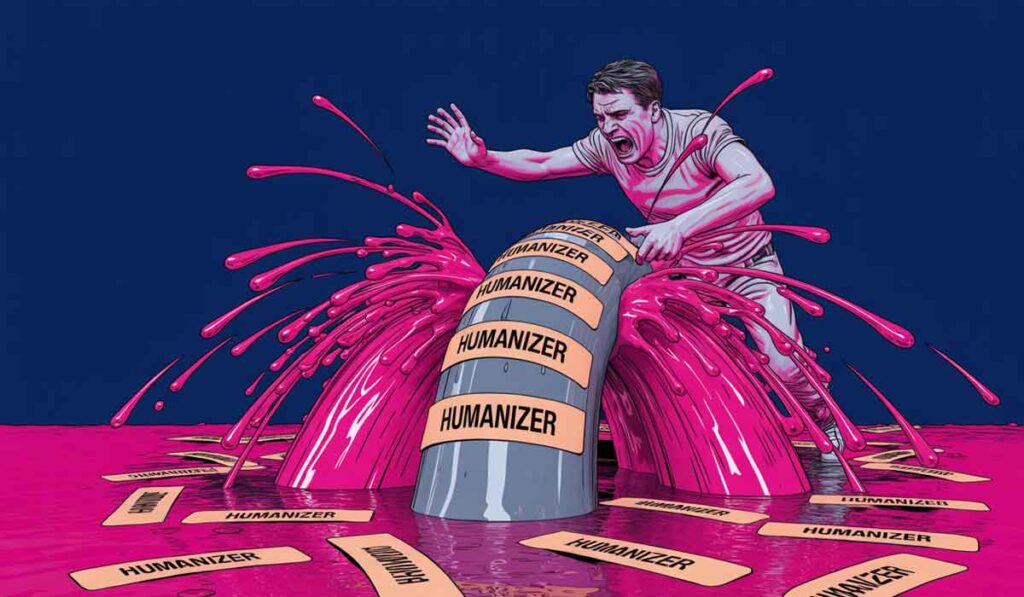
So what do people do when they realize their AI content sounds robotic?
They run it through a humanizer tool.
There are entire companies built around this. “Make your AI content sound human!” Undetectable AI. Bypass detection. Sound authentic.
I even tested one. Spent twenty bucks on credits just to see what happened.
Here’s the problem: if you need a tool to make your AI sound human, you’ve already lost.
You’re treating the symptom, not the disease.
Humanizer tools try to disguise AI writing as human writing.
That’s a cover-up, not a fix.
It’s like putting a filter on a bad photo instead of learning to take better photos.
The composition is still wrong. The lighting is still off. The filter just disguises the mediocrity.
Grammarly Is Different
Some people ask about Grammarly. Is that the same thing?
No. And the distinction matters.
Grammarly fixes YOUR writing. Grammar, spelling, clarity.
It polishes what’s already you.
It assumes you wrote it and helps you write better.
Humanizers assume AI wrote it and try to hide that fact.
One is a writing tool. The other is a cover-up tool.
If you need to disguise your content, you’ve already admitted the output isn’t yours.
What Actually Works
So what’s the fix?
Teach AI who you are before you ask it to write for you.
Not better prompts. Not humanizer tools. Not another template library.
You have to extract your thinking patterns first.
- Your vocabulary.
- Your frameworks.
- Your voice.
- Your opinions.
- Your experience.
Then when AI writes, it’s channeling YOU, not “generic helpful assistant.”
I call this the Intelligence Merge.
The Intelligence Merge in Action

Let me show you the difference with a real example.
I was working with a restaurant client.
They needed to respond to hundreds of Google reviews.
I set up AI to handle it.
Here’s what generic AI produced:
“Hi Joe, We’re sorry to hear that your meal didn’t taste good. Please call us at 480-555-5555 or email us at [email protected].”
Fake phone number the AI invented. Generic apology. No real solution. Robotic tone.
Here’s the same AI after I spent a month teaching it how the restaurant actually thinks & sounds:
“Hi Joe, We’re sorry to hear that your meal didn’t taste good. We have made the managers aware of the issue. If you’d like to come back by the restaurant, show us this review and we will take care of you. We appreciate you taking the time to leave this feedback as it’s very important to us to make sure that every customer has a good and consistent experience. We take comments like this to heart, and we want to make everything right.“
Same AI. Completely different output.
That Intelligence Merge has handled over 12,000 reviews in the 24 months since. Still running. Still accurate. Still on-brand.
One month of teaching AI. Two years of results.
What Changes When You Do This
When you do the Intelligence Merge:
Your AI output sounds like you, not like everyone else.
No humanizer tools needed because it’s already 80 to 90 percent of your voice.
People can’t tell AI helped because it’s genuinely your thinking, just accelerated.
You stop sounding like those four LinkedIn posts.
You start sounding like you.
AI just helped you do it faster.
Flattened or Amplified?
Here’s the choice in front of you.
You can use AI like everyone else. Ask it questions. Get generic answers. Maybe run it through a humanizer. Sound like the other 95 percent. (I wrote about why learning AI won’t save your job if you want the full breakdown.)
Or you can do something different.
You can extract your intelligence first.
Teach AI who you are.
Then merge your expertise with AI’s capabilities.
It’s your choice:
- Flattened or amplified.
- Generic or unique.
- Replaceable or irreplaceable.
Frequently Asked Questions
What is AI flattening?
AI flattening is when AI compresses your unique voice, expertise, and perspective into generic output that sounds like everyone else. It happens because AI is trained on the internet average, not on your specific experience and thinking patterns.
Why does all AI content sound the same?
AI content sounds the same because everyone uses AI the same way. They ask questions and paste answers without teaching AI who they are first. The input is generic, so the output is generic.
What are the signs of AI-generated content?
Common signs include phrases like “In today’s fast-paced world,” checkbox emoji lists, “isn’t just X, it’s Y” structures, Em Dashes, generic advice anyone could give, questions at the end that fish for engagement, and a lack of specific stories or examples.
Do humanizer tools actually work?
Humanizer tools disguise AI writing but don’t fix the underlying problem. If you need a tool to make your content sound human, the content itself is still generic. It’s a cover-up, not a solution.
What is Intelligence Merge?
The Intelligence Merge is the process of extracting your thinking patterns, vocabulary, frameworks, and voice, then teaching them to AI before asking it to create content. The output sounds like you because it’s built from your actual intelligence.
How long does the Intelligence Merge take?
A basic extraction can start with a 60-120-minute interview with about 43 questions. The investment pays off for years.
Can I do the Intelligence Merge without technical skills?
Yes. Intelligence Merge is about extracting your expertise and teaching it to AI, not about coding or technical setup. If you can answer questions about how you think and work, you can do the Intelligence Merge.
How do I know if my AI content is flattened?
Read your AI output and ask: could anyone in my industry have written this? If the answer is yes, it’s flattened. If it contains your specific stories, opinions, and voice, it’s merged.
Ready to Stop Sounding Like Everyone Else?
If your AI sounds like everyone else’s, it’s because you’re using it like everyone else.
There’s another way.
I’ve built a free interview process that starts the extraction. 43 questions, it takes about 60 – 120 minutes. It pulls out the patterns, the thinking, the voice that makes you unique. It gets you 50-60% of the way to a full Intelligence Merge.
Click here if you want to try it.
But either way, stop feeding AI your problems and hoping for magic.
Start teaching it who you are.
Build, Don’t Scroll.

Teaching the The Intelligence Merge Methodology.